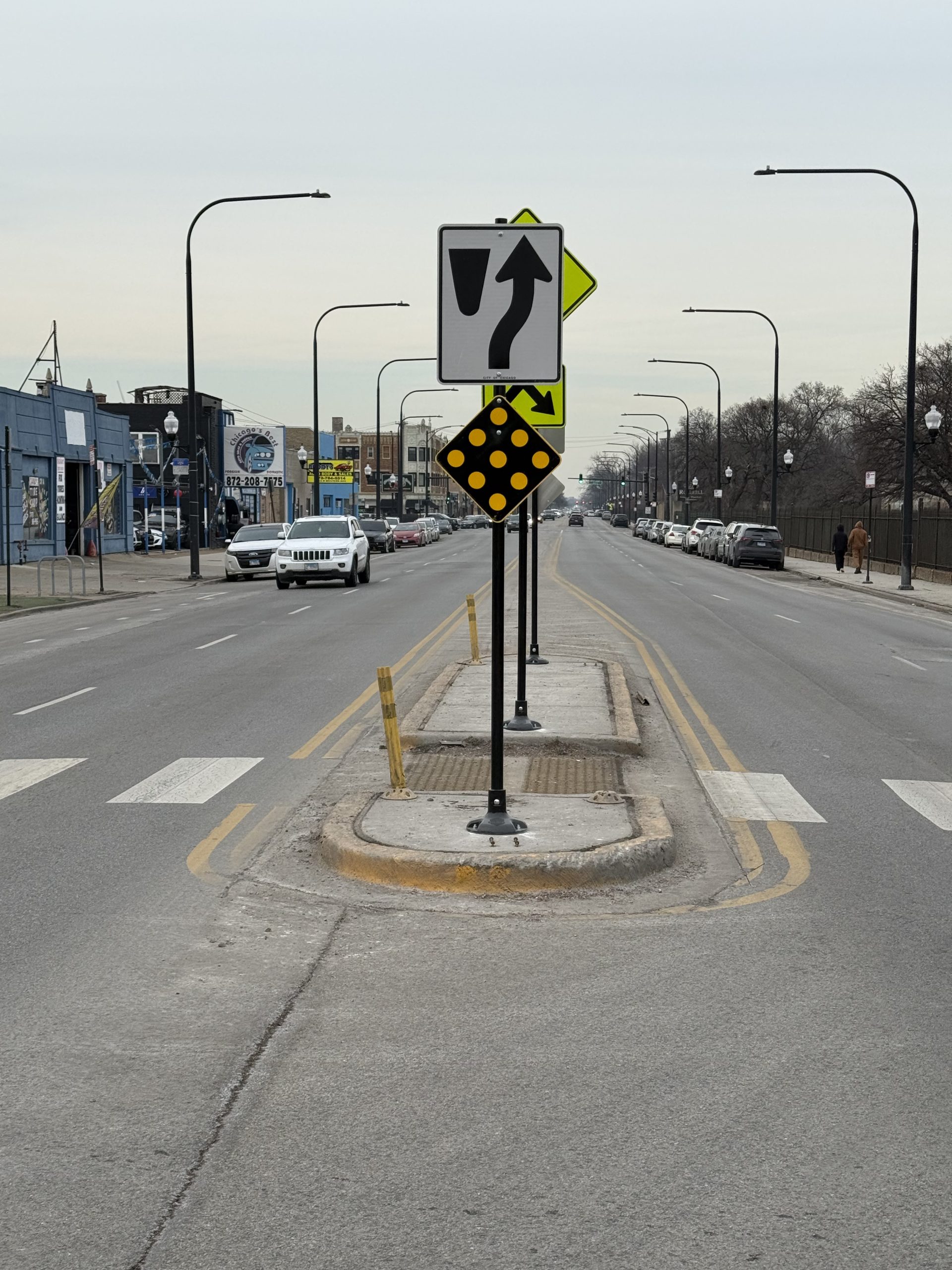
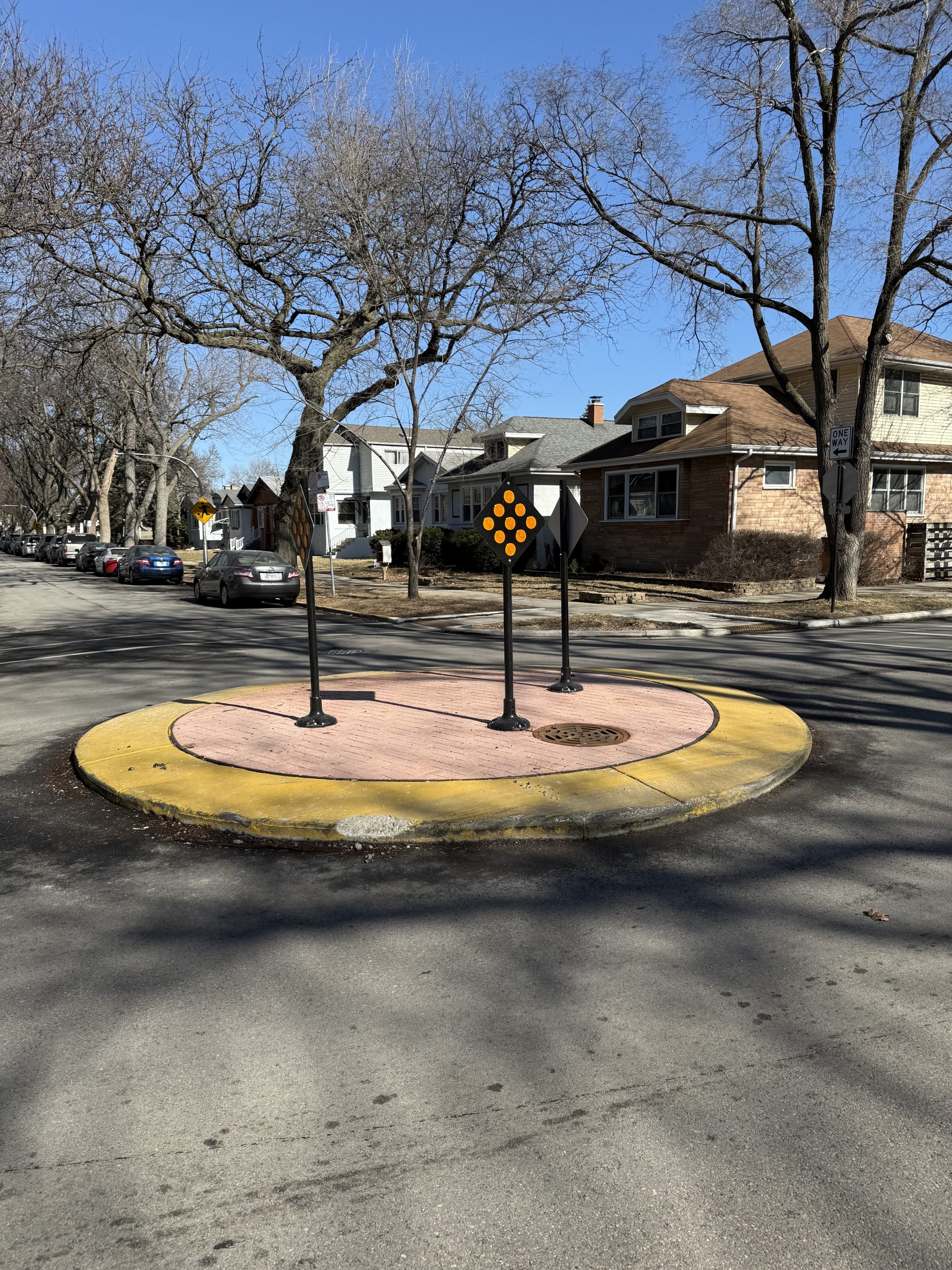
Across Chicago city planners have installed concrete bump-outs, pedestrian refuge islands, and protected bike lanes in the name of safety and traffic calming. While these features are designed to reduce pedestrian injuries and slow traffic, they can also pose serious dangers to motorists, especially when they are poorly marked, poorly lit, or difficult to see, especially at night. At night during a rain storm or snow storm with the glare of on coming traffic, they are remarkably easy to hit. I know from first hand experience since I hit the pedestrian island pictured above on the left at night during a rainstorm causing over $800 of damage to my car. The only difference being that when I hit it, the pedestrian island had no signage. The signage has been added recently probably as a result of complaints by drivers who rammed it.
The personal injury lawyers of Zneimer & Zneimer, P.C., have seen firsthand how these roadway designs can contribute to crashes resulting in severe vehicle damage and significant personal injuries.
This article we discuss the risks of bump outs and and what can be done to alleviate the risk.
- Concrete Bump-Outs (Curb Extensions)
Concrete bump-outs extend the sidewalk into the street at intersections or mid-block crossings. They are intended to:
- Shorten pedestrian crossing distance
- Improve pedestrian visibility
- Slow turning vehicles
However, when improperly designed or marked, they create hazards for drivers.
Why They Can Be Dangerous
- Low-profile concrete blends into pavement, especially at night
- Poor lighting makes them difficult to see in rain or snow
- Tight turning radii increase the risk of clipping the corner
- Snow accumulation hides the concrete edge
- Lack of reflective paint or vertical markers
Drivers unfamiliar with a neighborhood, or navigating glare, precipitation, or construction, can strike these structures unexpectedly.
A collision with a fixed concrete structure can cause:
- Airbag deployment
- Suspension and axle damage
- Loss of vehicle control
- Secondary collisions
- Concrete Pedestrian Refuge Islands
Pedestrian islands are placed in the center of multi-lane roads to allow pedestrians to cross in stages.
While helpful for walkers, they present visibility issues for drivers:
- Low concrete curbs that blend into asphalt
- Minimal signage in some locations
- Confusing lane shifts
- Lack of reflective or illuminated markers
- Hidden by parked cars or large vehicles
At night—especially during Chicago winters when roads are wet and glare is significant—these islands can appear as little more than a shadow until it is too late.
- Protected Bike Lanes with Concrete Barriers
Protected bike lanes often include:
- Concrete dividers
- Raised curbs
- Parking-protected designs
- Vertical posts or planters
While these installations protect cyclists, they can:
- Narrow travel lanes
- Eliminate recovery space
- Create unexpected fixed objects
- Obscure turning visibility
- Increase sideswipe risk
Drivers turning right across a protected bike lane often face multiple hazards at once: cyclists, pedestrians, traffic signals—and concrete barriers.
If not clearly marked, these structures can lead to serious impact crashes.
Why Visibility Matters
Motorists rely on:
- Contrast
- Reflectivity
- Lighting
- Predictable roadway geometry
When concrete features lack visual contrast or reflective treatment, they effectively become unmarked fixed obstacles.
Under Illinois law, municipalities have a duty to maintain reasonably safe roadways. While drivers must exercise due care, roadway design must also account for ordinary driver behavior—especially in low-light and adverse weather conditions.
How These Structures Can Be Made Safer
There are practical, cost-effective ways to dramatically improve safety.
- High-Contrast Paint
- Bright white striping
- Reflective yellow edging
- Diagonal hazard markings
- Reflective Delineators & Bollards
- Flexible reflective posts
- Raised reflective pavement markers
- Impact-resistant vertical panels
- Better Lighting
- Overhead LED lighting at intersections
- Solar-powered reflective studs
- Illuminated curb edges
- Advance Warning Signage
- “Raised Island Ahead”
- Chevron hazard boards
- Reflective directional arrow
If you have been injured in an car crash, the personal injury lawyers of Zneimer & Zneimer, P.C. will be happy to provide you with a free consultation to evaluate your case.