 Chicago Accident Lawyer Blog


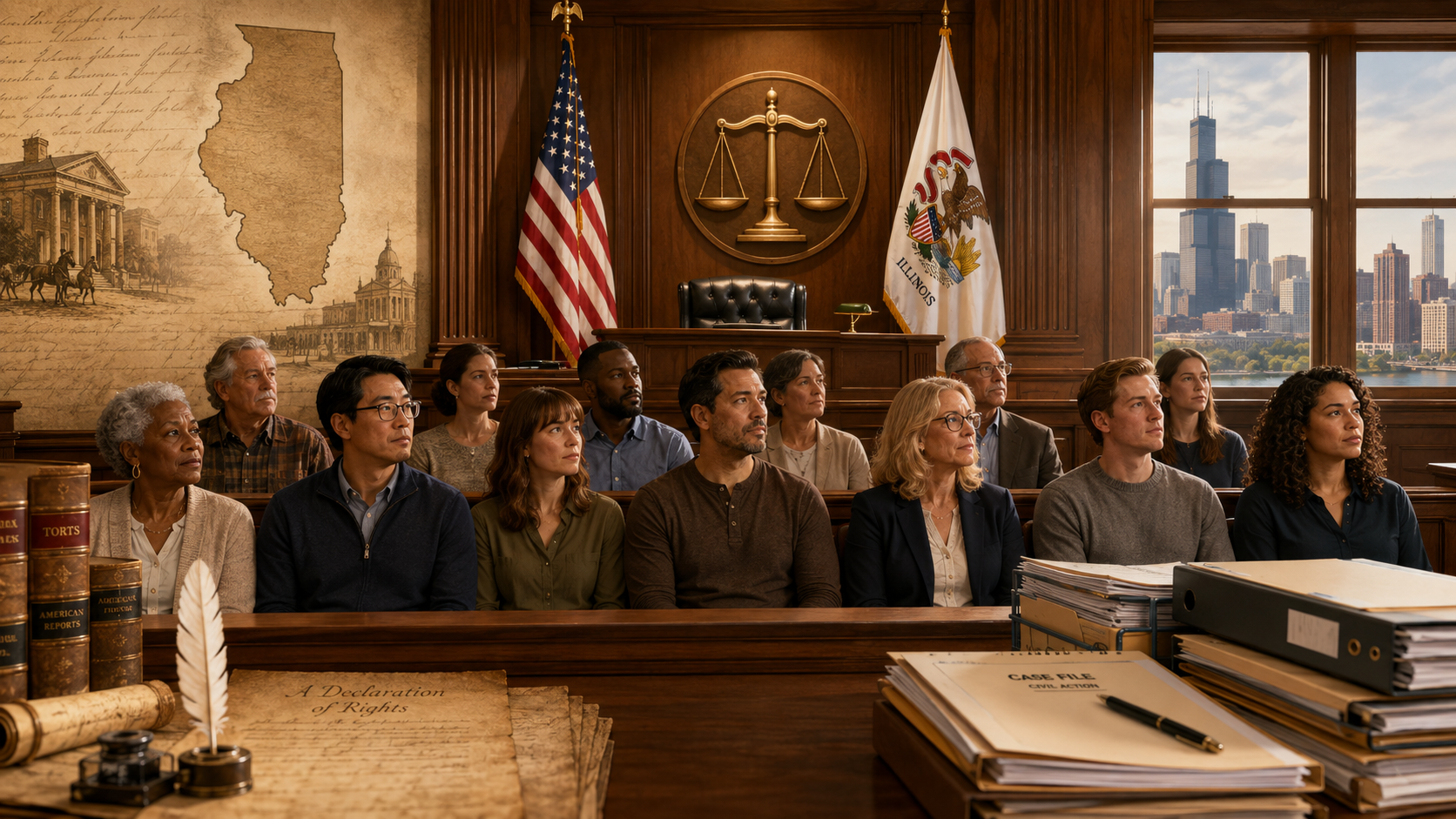
The History of Tort Law and the American Jury: Putting Faith in Ordinary People
When someone is injured because another person or company was careless, the right to seek compensation may seem like an ordinary part of American law. But the modern personal injury case is the product of centuries of legal development.
American tort law did not begin with a single statute or constitutional provision. It grew from the English common law, was reshaped by American courts and legislatures, and continues to evolve as society, technology, transportation, medicine, and commerce change.
Just as important is the institution that often decides these cases: the civil jury.
The American civil jury represents a remarkable idea. When important facts are disputed—whether someone was negligent, whether that negligence caused an injury, and what compensation is fair—we entrust those decisions not solely to government officials, judges, corporations, insurance companies, or experts, but to ordinary citizens.
That reflects an extraordinary degree of faith in the people themselves.
What Is Tort Law?
A “tort” is generally a civil wrong that causes injury or harm and gives the injured person a legal right to seek a remedy.
Tort law includes claims arising from:
- automobile and truck crashes;
- unsafe property;
- medical negligence;
- defective products;
- bicycle and pedestrian crashes;
- wrongful death;
- intentional misconduct; and
- countless other situations in which one person’s conduct causes injury to another.
The central purpose of compensatory tort damages is straightforward: to compensate an injured person for the losses caused by the wrongful conduct. The Illinois Supreme Court has described the compensatory goal of tort law as making the injured plaintiff whole to the extent money can do so. (Illinois Courts)
That principle sounds simple. Its history is anything but simple.
The English Common-Law Roots of American Tort Law
American tort law grew primarily from the English common law.
Common law differs from a comprehensive statutory code. Instead of lawmakers attempting to anticipate every possible human dispute, legal principles developed gradually through decisions made by judges in actual cases.
Early English law did not contain “tort law” in the organized form lawyers recognize today. A person’s ability to recover often depended upon fitting the claim into particular forms of legal action.
Over centuries, those technical forms gradually developed into broader principles governing wrongful conduct.
Concepts such as trespass, nuisance, assault, battery, responsibility for dangerous activities, and eventually negligence grew out of this tradition.
The common law was therefore evolutionary. Courts confronted new circumstances, applied earlier principles, distinguished previous decisions when necessary, and gradually developed rules governing responsibility for injuries.
That tradition crossed the Atlantic.
Tort Law Comes to America
After independence, the new United States did not discard the entire body of English law. American states generally retained much of the common law that was compatible with their new legal systems.
American courts then developed that law independently.
During the nineteenth century, American tort law grew enormously as the country changed.
America went from a largely agricultural society to a nation of factories, railroads, machinery, crowded cities and eventually automobiles. Those developments created forms of injury that earlier generations could scarcely have imagined.
Courts increasingly confronted a fundamental question:
When should one person or business be required to compensate another person for an injury?
From those cases emerged the modern law of negligence.
The Rise of Negligence Law
Negligence eventually became one of the central concepts of American tort law.
At its most basic level, negligence involves failing to exercise the degree of reasonable care required under the circumstances. (Legal Information Institute)
Modern negligence cases generally revolve around familiar concepts:
Duty. Did the defendant owe the injured person a legal duty?
Breach. Did the defendant fail to exercise reasonable care?
Causation. Did that failure cause the injury?
Damages. What losses resulted?
But these principles have never existed in a vacuum. What constitutes “reasonable care” changes with circumstances.
The precautions reasonably expected of someone driving a horse-drawn wagon in 1850 are obviously different from those expected of someone operating a tractor-trailer on the Kennedy Expressway today.
The underlying principle survives because it is flexible:
People must exercise reasonable care when their conduct creates foreseeable risks to others.
That flexibility is one reason the common-law system has survived enormous technological and social change.
Tort Law Has Always Been a Combination of Judge-Made Law and Statutes
Although tort law originated largely in the common law, legislatures have also played an increasingly important role.
Statutes may create rights, modify common-law rules, regulate dangerous activities or determine how particular claims operate.
Wrongful death provides a particularly important example.
Historically, the common law generally did not provide the type of wrongful-death remedy we recognize today. Legislatures eventually corrected that harsh result.
Illinois enacted its Wrongful Death Act in 1853. The law provides a cause of action when death results from a wrongful act, neglect or default under circumstances in which the injured person could have maintained an action had death not occurred. (Illinois General Assembly)
That development illustrates an important characteristic of tort law.
The law is not frozen.
Courts develop common-law principles. Legislatures enact statutes. Constitutions impose limits on government. And each generation confronts new questions about responsibility, safety and justice.
The Development of Tort Law in Illinois
Illinois tort law developed from this same common-law tradition, supplemented by statutes enacted by the Illinois General Assembly and decisions of the Illinois Supreme Court and appellate courts.
One major example involves contributory negligence.
Under the old common-law contributory-negligence rule, an injured plaintiff’s own negligence could completely prevent recovery—even when the defendant was also substantially negligent.
The result could be extraordinarily harsh.
Suppose a jury believed a defendant was 90% responsible for an accident and the injured plaintiff only 10% responsible. Under strict contributory negligence, that 10% could prevent the plaintiff from recovering anything.
Illinois eventually rejected that rule.
In the landmark 1981 decision Alvis v. Ribar, the Illinois Supreme Court abolished contributory negligence as a complete bar and adopted comparative negligence. The court initially adopted “pure” comparative negligence, under which a plaintiff’s damages were reduced according to the plaintiff’s percentage of fault rather than automatically eliminated. (Illinois Courts)
The Illinois legislature later adopted the modified comparative-fault system that generally governs negligence cases today.
Under current Illinois law, a plaintiff who is more than 50% responsible for the injury is barred from recovery. If the plaintiff is 50% or less responsible, damages are reduced according to the plaintiff’s percentage of fault. (Illinois General Assembly)
Again, tort law evolved because the legal system concluded that an older rule could produce unjust results.
Tort Law Continues to Evolve
Modern tort law now addresses circumstances unimaginable to the judges who developed the early common law.
Courts and juries may confront questions involving:
- autonomous and semi-autonomous vehicles;
- rideshare companies;
- electric bicycles and scooters;
- sophisticated medical technology;
- artificial intelligence;
- massive commercial trucking operations;
- complex pharmaceuticals and medical devices;
- industrial chemicals;
- data and electronic evidence; and
- products distributed through global supply chains.
Technology changes.
The basic question does not:
When someone’s unreasonable conduct injures another human being, who should bear the consequences?
Without tort law, much of the financial burden of an injury could simply fall upon the innocent victim and the victim’s family.
Tort law allows that person to require the responsible party to answer for what happened.
The Jury Is Older Than the United States
The jury system also comes from English legal tradition.
Its roots extend back many centuries, although the jury gradually evolved from something very different from the modern institution.
By the time of the American founding, trial by jury had become deeply associated with English liberty and limitations on government power.
The American colonists brought that tradition with them.
Their experience with British rule strengthened the belief that citizens should participate directly in the administration of justice rather than leaving important decisions entirely in the hands of government officials.
That idea became embedded in American constitutional law.
The Seventh Amendment Protects Civil Juries
Most Americans know that criminal defendants have a constitutional right to a jury trial.
Less widely understood is that the Constitution also protects the civil jury.
The Seventh Amendment to the United States Constitution provides that in suits at common law exceeding the constitutional amount in controversy, “the right of trial by jury shall be preserved.” (Constitution.gov)
The Seventh Amendment applies to civil cases in federal court within its historical scope and also restricts the ability of courts to reexamine facts found by a jury. (Constitution.gov)
The Founders did not regard the civil jury as an incidental procedural convenience.
They thought it important enough to put into the Bill of Rights.
Illinois Goes Even Further
Illinois separately protects jury trials in its own Constitution.
Article I, Section 13 of the Illinois Constitution declares:
“The right of trial by jury as heretofore enjoyed shall remain inviolate.” (Illinois Legislative Research Bureau)
Immediately preceding that protection is another remarkable provision.
Article I, Section 12 states that every person shall find a remedy in the laws for injuries and wrongs to the person’s body, privacy, property or reputation and should obtain justice “freely, completely, and promptly.” (Illinois Legislative Research Bureau)
Together, these provisions express something fundamental about Illinois law.
The courthouse is not supposed to belong only to government, corporations, insurance companies or the wealthy.
It belongs to the people.
What Makes the American Civil Jury So Unusual?
Many countries use judges rather than juries to decide ordinary civil disputes.
The extensive American use of juries in civil cases—particularly personal injury cases—is unusual internationally.
That distinction matters.
In an American personal injury trial, the people who ultimately decide many of the most important questions may not be professional judges, government employees or bureaucrats.
They are citizens.
A teacher.
A construction worker.
An accountant.
A retiree.
A nurse.
A store employee.
A business owner.
People from different neighborhoods and different walks of life are brought together, hear the evidence, receive instructions on the law from the judge, deliberate with one another and reach a verdict.
There is something profoundly democratic about that process.
The Jury System Puts Faith in Ordinary People
The jury system rests upon a proposition that is easy to overlook:
Ordinary people are capable of administering justice.
Our system does not assume that wisdom resides exclusively in government institutions or highly credentialed experts.
Instead, it asks citizens to listen.
To judge credibility.
To weigh conflicting evidence.
To apply community standards of reasonable conduct.
And ultimately to decide what is fair.
That is an extraordinary expression of faith in democratic self-government.
A jury is democracy brought directly into the courtroom.
Citizens do not merely vote for officials who administer the justice system.
For a brief period, they become part of the justice system themselves.
Why Juries Matter to Injured People
The importance of juries becomes particularly clear in personal injury cases.
Imagine an individual seriously injured by the negligence of a large corporation.
On one side may stand an ordinary person whose life has been permanently changed.
On the other may be a corporation or insurance company with enormous financial resources, lawyers, experts and institutional power.
The jury system changes that equation.
The final decision does not belong to the corporation.
It does not belong to its insurance company.
It does not belong to the injured person’s lawyer.
And on disputed factual issues, it does not simply belong to the government.
It belongs to citizens who have heard both sides.
That is an important equalizer.
Juries Decide What “Reasonable” Means
Negligence law frequently depends upon the conduct of the hypothetical “reasonable person.”
But reasonableness cannot always be reduced to a mathematical formula.
Was the driver traveling too fast for the conditions?
Should a store have discovered a dangerous condition?
Did a trucking company take reasonable precautions?
Did a property owner respond appropriately to a known danger?
Was a warning adequate?
Did someone’s conduct cause the plaintiff’s injury?
These questions involve evidence, but they also involve judgment.
The jury brings the collective judgment and common sense of the community into the courtroom.
That is particularly appropriate because tort law is, in many respects, about the standards we expect people to follow when their conduct can injure others.
Juries Also Decide the Human Value of an Injury
Some losses can be measured with relative precision.
A hospital bill has a dollar amount.
Lost wages can often be calculated.
The cost of future medical care can sometimes be estimated through expert testimony.
But serious injuries involve losses that cannot be found on an invoice.
How much is it worth to permanently lose the ability to walk without pain?
What is the value of being unable to pick up your grandchild?
What compensates someone who can no longer work at a profession that defined much of his or her life?
What is the value of permanent disfigurement?
How does one measure years of pain, disability or loss of a normal life?
There is no stock exchange establishing the market value of human suffering.
Someone must make that judgment.
Our legal system entrusts it to juries.
The Jury Is Also a Check on Concentrated Power
The civil jury has another important function.
It disperses power.
A society could decide that disputes between individuals and large institutions should always be decided by government officials. It could permit legislatures or bureaucracies to establish predetermined values for every injury.
America largely chose another path.
In appropriate cases, citizens themselves sit between the individual and concentrated power.
This does not mean juries always rule for injured people. They do not.
Plaintiffs lose cases.
Juries reject claims they do not believe.
They reduce damages when they believe a plaintiff bears part of the responsibility.
They evaluate witnesses and determine whether a plaintiff has met the required burden of proof.
That independence is precisely what gives jury verdicts legitimacy.
A jury is not supposed to be a plaintiff’s institution or a defendant’s institution.
It is supposed to be the people’s institution.
Juries Require Trust
Every jury trial involves risk.
Neither side knows with certainty what twelve—or, under Illinois procedures, the required group of jurors hearing a particular case—will conclude after listening to the evidence.
That uncertainty can make jury trials uncomfortable for powerful institutions accustomed to controlling risk.
But the alternative raises a deeper question:
Whom do we trust?
The American system answers that question in a distinctive way.
We trust citizens.
We trust them to distinguish a legitimate claim from an illegitimate one.
We trust them to recognize negligence.
We trust them to reject exaggeration.
We trust them to understand human loss.
And we trust them to hold powerful defendants accountable when the evidence requires it.
Tort Law Does More Than Compensate
Compensation is central to tort law, but tort law also creates accountability.
Rules of civil responsibility encourage drivers to drive carefully, businesses to maintain safe premises, manufacturers to make safer products and professionals to follow appropriate standards of care.
Most people will never read an appellate decision discussing negligence.
They do, however, live in a society shaped by those decisions.
Safety rules, warnings, training procedures, product improvements and corporate practices frequently exist because experience has demonstrated the terrible consequences of failing to take reasonable precautions.
Civil accountability creates an economic and legal reason to prevent the next injury rather than simply apologize for the last one.
The Law Has Changed, but the Principle Remains
From medieval English common law to nineteenth-century American industrialization, from the rise of the automobile to modern Illinois comparative negligence, tort law has continuously evolved.
Its rules have changed because society has changed.
But one principle has endured:
A person wrongfully injured by another should have access to a court and an opportunity to obtain justice.
Illinois expresses that principle directly in its Constitution through both the right to a remedy and the preservation of trial by jury. (Illinois Legislative Research Bureau)
Those rights should never be taken for granted.
Why Zneimer & Zneimer P.C. Believes the Civil Jury Matters
At Zneimer & Zneimer P.C., we represent injured people.
That means we see the civil justice system from the perspective of people who may suddenly find themselves confronting insurance companies, corporations and institutions with far greater financial resources than their own.
A serious injury can change a person’s life in seconds.
A crash, unsafe property condition or other negligent act can result in medical treatment, lost income, disability, pain and uncertainty about the future.
The civil justice system gives that person something enormously important:
a voice.
And when a case cannot be fairly resolved, the jury system gives that individual the right to stand in a courtroom, present evidence and ask fellow citizens to decide the case.
That right has been developed and defended over centuries.
It reflects one of the most democratic ideas in American law:
Justice is too important to be entrusted only to the powerful.
Sometimes it must be entrusted to the people.
And that is why the civil jury remains one of the most important institutions in American tort law.